
How Many Watermelons Are in the Picture? The Viral Puzzle Explained
At first glance, this watermelon puzzle looks incredibly simple. The image shows several circular watermelon slices arranged in a neat pattern, and the large question at the top asks: “How many watermelons are in this picture?” Beneath it is another tempting statement claiming that 90% of people get the answer wrong.
That extra sentence is exactly what makes the puzzle interesting. Instead of simply counting the visible pieces, many people immediately begin searching for a hidden trick. Is there a watermelon hiding somewhere? Do the slices represent complete fruits? Should two halves be counted as one watermelon? Or is the answer simply the number of watermelon pieces that can be seen?
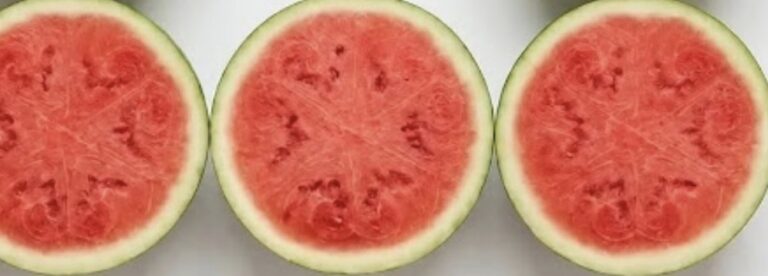
The image contains eight visible watermelon slices. There are three across the top, two in the middle, and three along the bottom. If the question means “How many watermelon pieces can you see?” the straightforward answer is therefore eight.
However, the puzzle can be interpreted differently, which is why it has become the kind of visual brain teaser that encourages people to debate the answer.
The First Step: Count What You Can See
The easiest way to approach the puzzle is to ignore the wording for a moment and simply count the objects.
Start at the top row. There are three round watermelon slices:
- One on the upper left.
- One in the upper center.
- One on the upper right.
Move down to the second row. There are two more:
- One on the middle left.
- One on the middle right.
Finally, look at the bottom row:
- One on the lower left.
- One in the lower center.
- One on the lower right.
That gives us a total of eight visible watermelon slices.
This is the most obvious answer, and it is probably the answer most people would give if they were asked to count the objects shown in the photograph.
But the wording does not say “How many watermelon slices are there?” It says “How many watermelons are in this picture?” That small difference creates an important question.
Are the Pictures Whole Watermelons or Slices?
A watermelon is normally considered to be the entire fruit. What we see in the image, however, are circular cross-sections cut from watermelons.
That means each visible circle represents a slice or section of a watermelon, rather than an entire intact watermelon.
If every slice came from a different fruit, then there could have been eight watermelons before they were cut. But the image does not provide enough information to know whether the slices came from eight separate fruits, four fruits cut in half, or some other number.
This is where the puzzle becomes a matter of interpretation rather than simple arithmetic.
If you treat each visible piece as a watermelon for the purpose of the puzzle, the answer is eight.
If you insist on using the literal definition of a whole watermelon, the image does not actually show any complete watermelons. It shows pieces of watermelon.
Could the Answer Be Four?
Another possible interpretation is that each circular piece is half of a watermelon.
If every visible slice were exactly one-half of a watermelon, two slices would make one complete watermelon. With eight slices, you could theoretically form:
8 ÷ 2 = 4 whole watermelons.
Under that assumption, the answer would be four.
But there is an important problem: the image does not show that these slices are necessarily halves of whole watermelons. They are circular cross-sections, and they could simply be individual slices cut from larger fruits.
So four is an interesting mathematical interpretation, but it is not something we can prove from the picture alone.
Why Visual Puzzles Trick Our Brains
The reason puzzles like this are so popular is that our brains naturally try to solve visual problems quickly.
When we see eight bright red circular objects with green rinds, our brain immediately recognizes them as watermelon slices. We do not normally stop to analyze whether each object represents a complete fruit or only a portion of one.
The large text at the top also influences the way we look at the image. Once we are told that most people supposedly get the puzzle wrong, we start expecting a trick.
This creates a psychological effect: instead of trusting the obvious answer, we begin looking for something hidden.
Sometimes that is exactly what the puzzle creator wants.
The Power of Misleading Wording
The phrase “How many watermelons are in this picture?” is deliberately different from “How many watermelon slices are in this picture?”
If the question asked for slices, there would be very little debate. Eight are clearly visible.
But the word “watermelons” makes us think about the fruit itself rather than the pieces shown in the photograph.
This is a classic technique used in brain teasers. The challenge is often not difficult mathematics. Instead, the challenge is understanding exactly what the question is asking.
A good puzzle solver should therefore avoid rushing to an answer. First, identify the objects. Then examine the wording. Finally, consider whether the question contains an assumption that is not supported by the image.
The Layout Makes Counting Easier
The arrangement of the slices also helps us count them.
The watermelon pieces form a roughly rectangular pattern around an empty space in the center. The first row contains three pieces. The middle section contains two pieces, one on either side. The final row contains three.
This creates a simple pattern:
3 + 2 + 3 = 8.
The empty area in the center can make the image look more complicated than it really is. Because the watermelons surround a large white space, some viewers may spend time searching inside the gap for a hidden object.
There is no visible additional watermelon there.
The easiest method is to count systematically from one side to the other rather than scanning randomly.
What Does “90% Get It Wrong” Mean?
The statement claiming that 90% of people get the puzzle wrong should also be treated carefully.
There is no information in the image itself that proves that exactly 90% of people would choose the wrong answer. Such statements are commonly added to online puzzles because they make people curious and encourage them to test themselves.
The wording creates a challenge:
“If most people get it wrong, can I get it right?”
That feeling encourages viewers to stop scrolling, examine the image, and possibly share it with friends.
Whether or not the percentage is based on actual research, the statement serves an important purpose: it turns an ordinary counting exercise into a competition.
So What Is the Best Answer?
If the goal is to answer the visual puzzle as it is normally presented online, the strongest answer is:
There are 8 visible watermelon pieces.
There are three on the top row, two in the middle, and three on the bottom.
If someone interprets the question literally and asks how many complete watermelons are visible, the answer could be zero, because none of the objects is an intact whole watermelon.
If someone assumes every circular piece is exactly half of a watermelon, they could calculate four whole watermelons.
But that assumption is not established by the picture.
Therefore, the most defensible answer based strictly on what is visible is eight watermelon slices.
Why People May Give Different Answers
The interesting part of this puzzle is that different answers can arise from different definitions.
Someone focused on counting visible objects will say eight.
Someone focused on whole fruits may say zero.
Someone assuming each slice represents half of a fruit may say four.
This does not necessarily mean one person is better at puzzles than another. It shows how much wording matters.
In everyday conversation, people often use the name of a food to refer to a piece of it. For example, someone might say, “I ate two pizzas,” even when the pizzas were cut into slices. In a puzzle, however, precise wording can change the intended answer.
A Simple Strategy for Solving Similar Puzzles
When you encounter another viral visual brain teaser, do not immediately search for an elaborate trick.
Instead, follow four simple steps.
First, count the obvious objects.
Look at the image systematically and establish the basic number.
Second, read the question carefully.
Words such as “whole,” “pieces,” “pairs,” “different,” and “visible” can completely change the answer.
Third, separate facts from assumptions.
Only use information that the image actually provides. If you assume something, recognize that it is an assumption.
Fourth, check for hidden objects or patterns.
Once the obvious answer is established, inspect the image again for anything concealed, duplicated, or represented indirectly.
This approach prevents you from being fooled by unnecessary complexity.
The Fun Is in the Debate
The best viral puzzles are often not difficult because of complicated mathematics. They are entertaining because they make people question their first impression.
This watermelon image is a perfect example. The visible count is easy: there are eight circular watermelon pieces. The real challenge comes from asking what exactly should be counted.
That ambiguity gives the puzzle its appeal.
One person might confidently answer eight. Another might argue for four. Someone else might point out that the picture technically contains no complete watermelons at all.
And that is exactly why these puzzles spread so easily on social media. They invite people to comment, challenge friends, defend their answers, and compare how they interpreted the question.
Final Answer
After carefully examining the image, there are eight visible watermelon slices: three at the top, two in the middle, and three at the bottom.
So, if the puzzle is asking you to count the watermelon pieces shown in the photograph, the answer is:
8
The alternative answers of four or zero depend on additional interpretations that are not explicitly established by the image.
The real lesson is not just about counting watermelons. It is about slowing down, reading carefully, and distinguishing what you can actually see from what you assume. A simple picture can produce several answers when a question is worded ambiguously.
So the next time someone sends you a “90% of people get this wrong” puzzle, take a second before answering. Count carefully, examine the wording, and remember that the trick may not be hidden inside the picture—it may be hidden inside the question itself.